
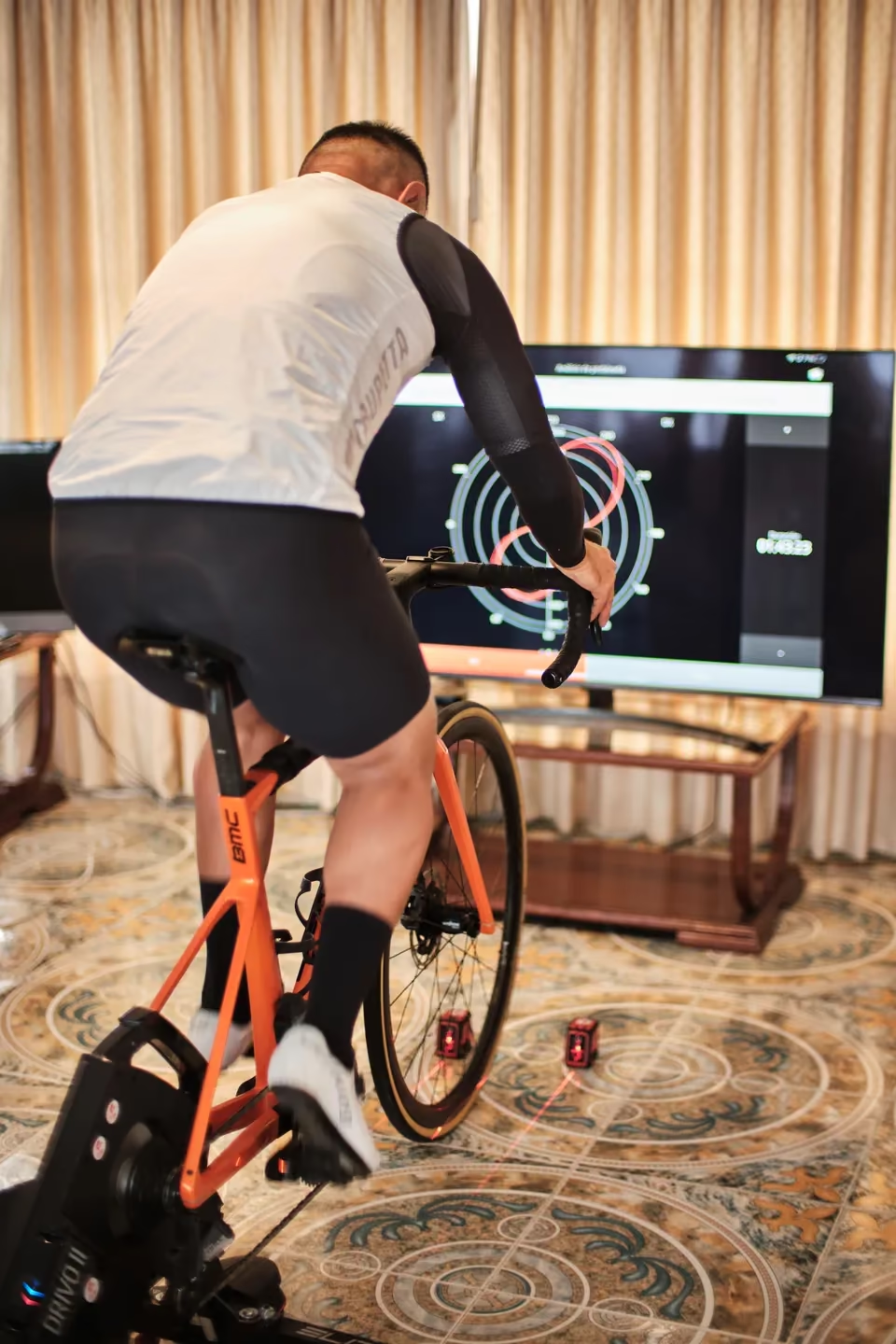
Indoor power test on the trainer to establish FTP

Summary

Training zones

Free calculator · Training and load

Work out your seven power zones from FTP and your five heart rate zones from threshold heart rate. Free, no sign-up.

What you need
Your FTP in watts and, if you want the heart rate zones too, your threshold heart rate. Both come from a test of your own: the average of your rides will not do.
What it gives you

The seven power zones on your FTP, each with its watt range.

The five heart rate zones on your threshold heart rate, and the three-zone threshold model.

A CSV file to view your zones in a spreadsheet or share them with your coach.

What it does not do

Zones are an arithmetic split of your FTP, not a physiological measurement: real thresholds only come out of a lactate or gas exchange test. And they expire: the FTP you enter here stops being valid the moment you improve.

5.0 on Google from 60 public reviews, verifiable on the laboratory listing.
All calculators

Free tool

Power and heart rate zone calculator

Enter your FTP and your threshold heart rate and get the seven power zones, the five heart rate zones and the three-zone model used to distribute training load. Copy the zones or download a CSV to open in a spreadsheet or share with your coach.

It runs in your browser. Nothing is sent, nothing is stored and no sign-up is needed. If you use the buttons below the calculator, the message is written here and opens in your own app: you decide whether to send it.

Calculator

Your references

The power you can hold for around an hour. If it comes from a 20-minute test, subtract 5 %.

Average heart rate over a maximal effort of 30 to 60 minutes. It is not your maximum heart rate, and it is not 220 minus your age.

To show each zone in watts per kilogram as well.

Three-zone model · the one that decides the split

This is the model used to decide how much time to spend at each intensity. The seven-zone one is for prescribing specific sessions.

Power zones

Power zones calculated on FTP
Zone% FTPWattsW/kgWhat for

Heart rate zones

Heart rate zones calculated on threshold heart rate
Zone% thresholdBeats

Heart rate lags in short intervals and drifts with heat, dehydration, fatigue and caffeine. Above zone 4, go by power or by feel.

Take the result with you

Send us this calculation and we will tell you what to do with it.

The button writes the message for you: what you entered, what came out and the name of the tool. It opens in your own app, already written, and you decide whether to send it. Nothing leaves this page until you do.

Your message opens ready to edit. Nothing is sent automatically.

Method and sources

References · 3 primary sourcesView the full citationsAllen et al. 2019 · Seiler 2010 · Jones et al. 2019

Primary sources and position statements the method on this page relies on.

  1. Allen, H., Coggan, A. R. and McGregor, S. (2019). Training and racing with a power meter (3.ª edición). VeloPress.
  2. Seiler, S. (2010). What is best practice for training intensity and duration distribution in endurance athletes?. International Journal of Sports Physiology and Performance.
  3. Jones, A. M., Burnley, M., Black, M. I., Poole, D. C. and Vanhatalo, A. (2019). The maximal metabolic steady state: redefining the ‘gold standard’. Physiological Reports.
The power zones come from the seven-zone model on FTP popularised by Allen and Coggan, the same one used by TrainingPeaks, WKO and most platforms. The heart rate zones are anchored on threshold heart rate rather than on maximum heart rate, following Joe Friel's five-band scheme: the 220-minus-age formula has a spread of more than ten beats between people of the same age, so anchoring there drags that error into every zone.

The three-zone model splits at the two physiological thresholds: below the first, between the two, and above the second. It is the model used to decide the intensity distribution, and its boundaries are placed at 75 % and 105 % of FTP as a field approximation.

Where it stops working

  • FTP is an estimate, not the threshold. A 20-minute test can land several watts above or below real maximal steady state depending on the rider’s profile. Two people with the same FTP may need different zones.
  • They expire. January’s zones do not work in April. Re-test every six to eight weeks.
  • At altitude they have to be redone. At 2,600 m threshold watts drop and the heart rate range compresses. Zones measured at sea level do not describe what you can hold on the Bogotá plateau.
Indoor power test on the trainer to establish FTP

When the formula is no longer enough

Well-calculated zones are not a plan.

These zones are correct if your FTP is correct and if it gets re-tested. What the table does not decide is how much time to spend in each one, when to raise load and when to stop. That comes from reading your response week by week.

See the training plans
ONEPERFORMANCE FINDER
Your next step starts here