
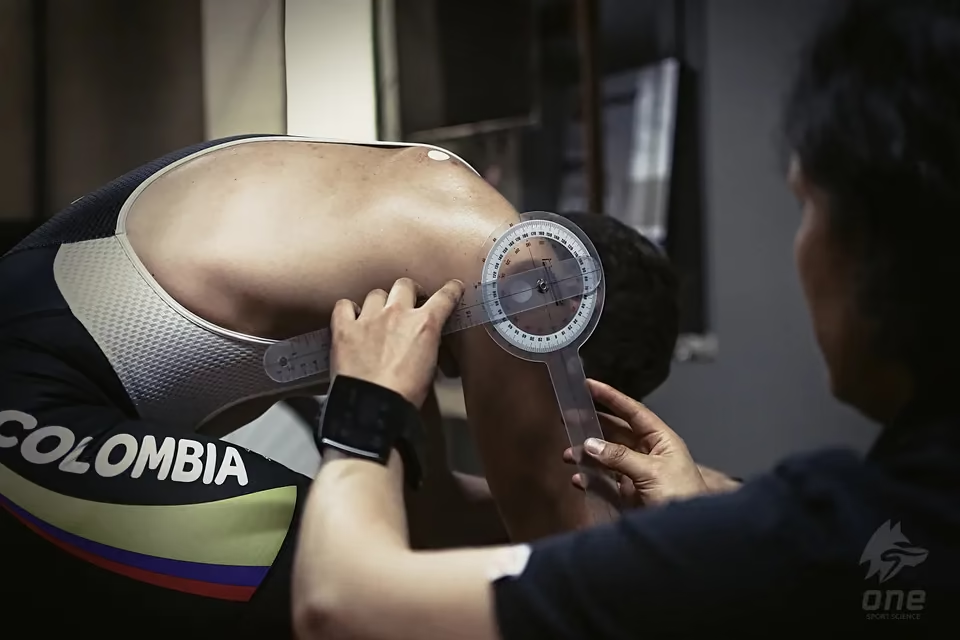
Anthropometry taken under protocol during a performance assessment

Summary

BMI and body composition

Free calculator · Nutrition and body composition

BMI, waist-to-height ratio and skinfold sum with how to read each one, and why BMI is so often wrong in a trained cyclist.

What you need
Weight, height and waist circumference. If you have a skinfold sum taken under protocol, enter it too: it is the most informative of the three.
What it gives you

The three indices ordered from the least to the most informative, with how to read each one.

Why BMI is frequently wrong in a trained cyclist, and in which direction.

Which change in each index means something, and which one sits inside measurement noise.

What it does not do

None of the three measures body fat and none of them is a diagnosis. A skinfold sum taken without ISAK protocol cannot be compared with the next one, or with anybody else’s.

5.0 on Google from 60 public reviews, verifiable on the laboratory listing.
All calculators

Free tool

BMI and body composition calculator for cyclists

BMI with the interpretation almost nobody adds: in a trained cyclist it is often wrong, and there are two indices that say considerably more. All three are here, with what each number means and with the warning that belongs there when the figure starts going too low.

It runs in your browser. Nothing is sent, nothing is stored and no sign-up is needed. If you use the buttons below the calculator, the message is written here and opens in your own app: you decide whether to send it.

Calculator

The basics

It changes the skinfold equations and the reference ranges, which are different.

Measure midway between the lowest rib and the top of the hip, after a normal exhalation, with the tape horizontal and without compressing the skin.

Skinfolds (optional)

If you have callipers and the six ISAK protocol measurements, in millimetres. If any of them is missing, leave the block empty: half a sum means nothing.

The three indices, from the least to the most informative

What each number means

What a kilogram is worth, in practice

Effect of body weight on the watts per kilogram ratio
WeightW/kg at 250 WOn the Alto de Patios

With power held constant. In practice it is not: losing weight too fast costs watts, and then the arithmetic reverses.Work out your case →

Take the result with you

Send us this calculation and we will tell you what to do with it.

The button writes the message for you: what you entered, what came out and the name of the tool. It opens in your own app, already written, and you decide whether to send it. Nothing leaves this page until you do.

Your message opens ready to edit. Nothing is sent automatically.

Method and sources

References · 2 primary sourcesView the full citationsMountjoy et al. 2023 · Thomas et al. 2016

Primary sources and position statements the method on this page relies on.

  1. Mountjoy, M., Ackerman, K. E., Bailey, D. M. et al. (2023). 2023 International Olympic Committee’s (IOC) consensus statement on Relative Energy Deficiency in Sport (REDs). British Journal of Sports Medicine.
  2. Thomas, D. T., Erdman, K. A. and Burke, L. M. (2016). Position of the Academy of Nutrition and Dietetics, Dietitians of Canada and the American College of Sports Medicine: nutrition and athletic performance. Journal of the Academy of Nutrition and Dietetics.
The three indices are deliberately ordered from least to most informative, and that hierarchy is the useful part of this tool.

1. BMI: the one that says least about a cyclist

Weight divided by height squared. It was designed to describe populations, not individuals, and it does not distinguish muscle from fat. In a trained cyclist that matters: a track sprinter with a lot of muscle mass can come out as “overweight” in their best form, and someone with little muscle and abdominal fat can come out “normal” with real metabolic risk. It is here because you will see it in any report, not because it is the best.

2. Waist-to-height ratio: better, and almost as easy

Waist circumference divided by height. It discriminates cardiometabolic risk better than BMI because it looks at where the fat is, not just how much there is, and abdominal fat is the one associated with the problem. The rule that sums up the usual threshold is direct: waist below half your height.

3. Skinfold sum: the one that lets you follow a change

The sum of the six ISAK protocol skinfolds, in millimetres. And here is this calculator’s editorial decision: the number to follow is the sum, not the percentage. The percentage appears below, derived with the Yuhasz equation and with its margin declared, because it is the figure everybody asks for; but the one that lets you compare with yourself in eight weeks is the sum in millimetres. The equations that turn skinfolds into a percentage were validated in specific populations and carry an error of several percentage points when applied outside them. The sum in millimetres avoids that step — it converts nothing — but it keeps the error of the measurement itself: to interpret a change you need to know the repeatability of the protocol and the smallest change it can detect. A stable bias against a reference method can coexist with good sensitivity to change; they are two different things.

If you still want the percentage, it is shown below with the equation declared and its margin. Treat it as orientation, not as data.

Where it stops working

  • Measuring skinfolds well is hard. Cheap callipers and a measurement taken without protocol can vary by more than 20 % between two people measuring the same subject. That is why ISAK accreditation requires demonstrating a technical error of measurement within limits before certifying.
  • It only compares with itself. A sum taken by someone else, with different callipers or at different sites is not comparable with yours. The series has value; the isolated figure, little.
  • Body composition is not a performance target. It is one variable among many, and the one that behaves worst when it is pursued directly.
Anthropometry taken under protocol during a performance assessment

When the formula is no longer enough

An estimated figure is not a measurement.

These formulas work with two or three numbers taken at home. An ISAK Level 2 anthropometry measures lengths, breadths, girths and skinfolds under an international protocol with controlled technical error, which is what makes it possible to compare two sessions months apart and know whether the change is real.

See the performance assessment
ONEPERFORMANCE FINDER
Your next step starts here