
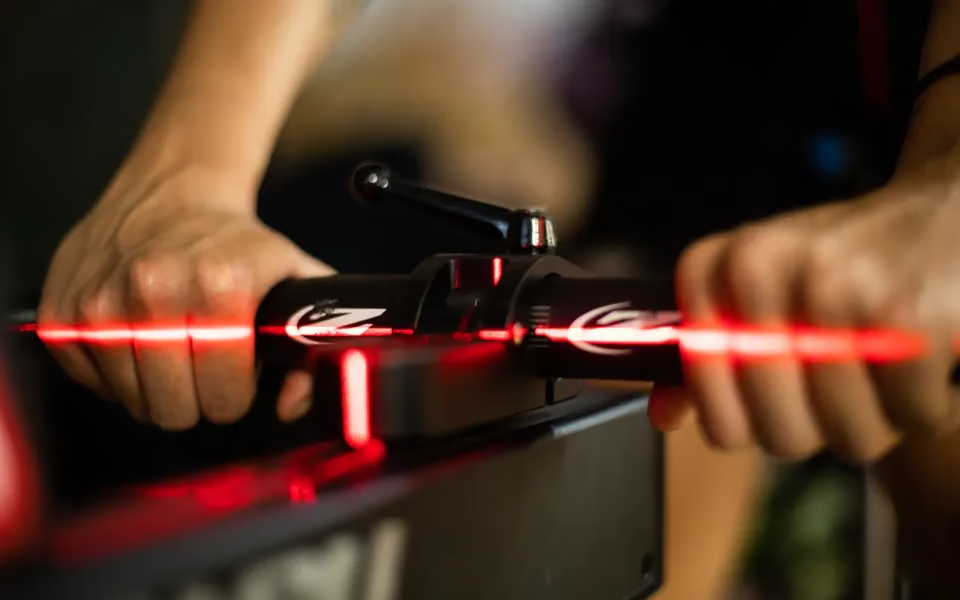
Cockpit alignment with a laser guide to measure stack and reach

Summary

Target stack and reach

Free calculator · Position on the bike

Turn your current position into the stack and reach window that reproduces it, so you know which frames work before you buy.

What you need
Your current saddle height and setback, horizontal saddle-to-handlebar distance and handlebar drop, plus stem length, stem angle and spacers.
What it gives you

The stack and reach window that reproduces your current position, not a single point.

Which frame and stem combinations fall inside that window.

Which component compensates each difference, and when the difference stops being compensable.

What it does not do

Reproducing stack and reach does not reproduce a bike: seat tube angle, crank length, handlebar and how the frame behaves all stay outside. And all of it assumes your current position is a good one, which is exactly what the calculator cannot know.

5.0 on Google from 60 public reviews, verifiable on the laboratory listing.
All calculators

Free tool

Target stack and reach calculator

Turn the position that already works for you into the geometry window that reproduces it. If your current bike feels right, this tells you which frames can give you the same thing and which ones cannot reach, which is the useful question before buying. It is a geometric estimate built on your measurements and the setup you declare.

It runs in your browser. Nothing is sent, nothing is stored and no sign-up is needed. If you use the buttons below the calculator, the message is written here and opens in your own app: you decide whether to send it.

Calculator

Your current position

With the bike on the ground and level. The first four define where your saddle and handlebar sit relative to the bottom bracket.

From the centre of the bottom bracket to the top of the saddle, along the seat tube.

Horizontal distance from the bottom bracket vertical to the nose of the saddle.

Horizontal, from the nose of the saddle to the centre of the handlebar.

How much lower the handlebar sits than the saddle. Negative if it sits higher.

In degrees, from your current bike’s geometry table. If you do not have it, 73.5° is typical on the road.

Your build

Geometry window that reproduces your position

Your stack to reach ratio

How to read the stack to reach ratio
RatioFrame shapeTypical use

How to use this window

    Take the result with you

    Send us this calculation and we will tell you what to do with it.

    The button writes the message for you: what you entered, what came out and the name of the tool. It opens in your own app, already written, and you decide whether to send it. Nothing leaves this page until you do.

    Your message opens ready to edit. Nothing is sent automatically.

    Method and sources

    References · 2 primary sourcesView the full citationsSilberman et al. 2005 · Fonda et al. 2014

    Primary sources and position statements the method on this page relies on.

    1. Silberman, M. R., Webner, D., Collina, S. and Shiple, B. J. (2005). Road bicycle fit. Clinical Journal of Sport Medicine.
    2. Fonda, B., Sarabon, N. and Li, F. X. (2014). Validity and reliability of different kinematics methods used for bike fitting. Journal of Sports Sciences.
    There is no statistical estimate here: it is trigonometry on the measurements you declare. Saddle height, with its seat tube angle, places the height of the support point relative to the bottom bracket; setback and reach place it along the bike, from the nose of the saddle; and travelling down the stem and the steerer axis leaves where the top of the head tube would have to be. That is the frame’s stack andreach. Precise trigonometry is not the same as an exact result: what you measured is what goes in.

    Three things are assumed: a head tube angle of 73°, common in medium road sizes; about 35 mm between the top of the head tube and the stem axis — the headset top cap and cup plus half a stem clamp; and a level saddle, so that its nose and the seat tube line sit at the same height. Spacers and headset are projected along the inclined steerer axis, not vertically: that is why moving spacers changes stack and reach at the same time. In extreme sizes the head tube angle deviates by a degree or two and the result moves a few millimetres; if your headset is unusually tall or short, add or subtract it from the spacers.

    Before ruling a frame out with this window, check it once: enter the measurements of a bike whose published geometry you know and confirm that the stack and reach that come out resemble its table. If they do not, what is wrong is one of your measurements, not the manufacturer’s table.

    The stack/reach ratio table is a different matter: it does not come from a study but from reading the geometry tables manufacturers publish. It describes how road, gravel and endurance frames are laid out today, and it helps you know which family to look at. It does not say which shape suits you.

    Where it stops working

    • It reproduces your current position, not the correct one.If your handlebar is too far away and your back hurts, this window will find you frames that faithfully reproduce that problem. The tool does not judge the starting position.
    • Home measurements carry error. Measuring saddle to handlebar reach with the bike against a wall and no plumb line can be off by five or ten millimetres. That is why the result is a window and not a figure.
    • Stack and reach are not the whole frame. Seat tube angle changes what setback you can achieve; chainstay length and wheelbase change how it behaves. Two frames with the same stack and reach can handle very differently.
    • The window can be shifted with components, up to a point.A different stem or more spacers move the result, but if you have to compensate more than 20 or 25 mm, the frame was not yours.
    Cockpit alignment with a laser guide to measure stack and reach

    When the formula is no longer enough

    This rules frames out. Choosing yours is another matter.

    The window comes from the position you declare, and that position may not be the best one for you. In a pre-purchase assessment the optimal position is defined first by measuring the body, and only then are specific models compared on their digital twins.

    See BIKEFINDER 3D
    ONEPERFORMANCE FINDER
    Your next step starts here