
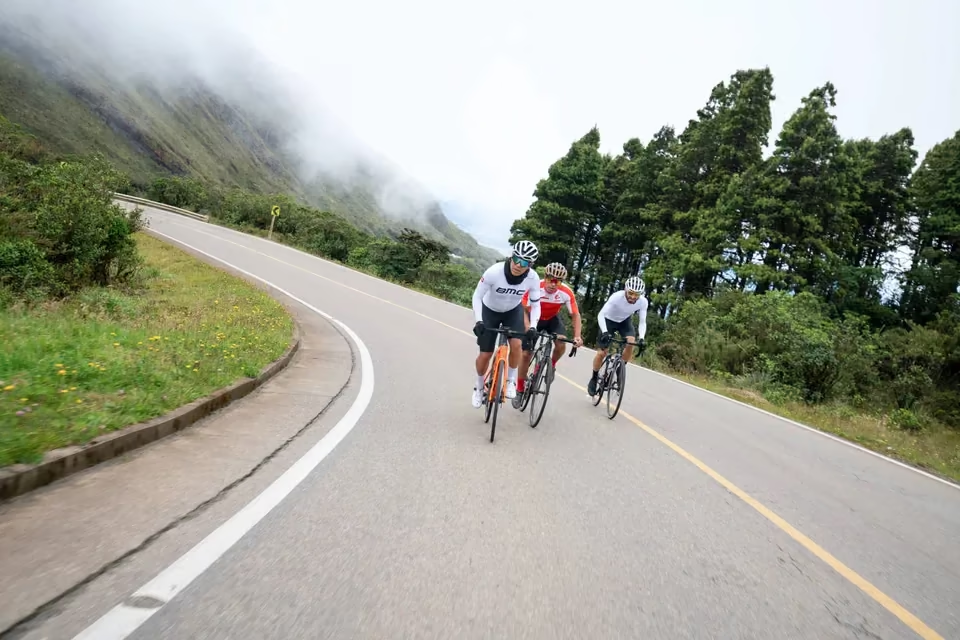
Cyclist climbing a mountain pass in fog

Summary

Gearing and cadence

Free calculator · Equipment and gearing

Speed for every chainring and sprocket combination, and whether your easiest gear is enough for the ramp with the power you have.

What you need
The chainrings and sprockets on your drivetrain and your wheel circumference. For the ramp check, your weight and the power you can hold as well.
What it gives you

The speed of every chainring and sprocket combination at the cadence you choose.

Whether your easiest gear is enough for that ramp with the power you have today.

How much gearing is missing when it is not, so you know what to change instead of changing everything.

What it does not do

This is drivetrain geometry and terrain physics: it does not know how you pedal or how much you can take today. A gear existing on paper does not mean you can hold it for twenty minutes.

5.0 on Google from 60 public reviews, verifiable on the laboratory listing.
All calculators

Free tool

Gearing and cadence calculator

What speed each chainring and sprocket combination gives at whatever cadence you choose, and — the thing that really matters before buying a groupset — whether your easiest gear is enough for the gradient you are going to climb with the power you have.

It runs in your browser. Nothing is sent, nothing is stored and no sign-up is needed. If you use the buttons below the calculator, the message is written here and opens in your own app: you decide whether to send it.

Calculator

Your drivetrain

Rolling circumference. It is what turns one wheel revolution into metres travelled.

Is it enough for the ramp?

You plus the bike.

It only touches the physical side: position, tyre and state of the drivetrain. On a ramp it weighs little, but it is there.

Speed per chainring and sprocket combination

In km/h at the cadence shown. Cross-chained combinations — big ring with big sprocket, or the reverse — are in brackets: they work, but they force the chain diagonally, wear it out sooner and are better avoided. The highlighted row is the largest rear sprocket.

Reading

    Take the result with you

    Send us this calculation and we will tell you what to do with it.

    The button writes the message for you: what you entered, what came out and the name of the tool. It opens in your own app, already written, and you decide whether to send it. Nothing leaves this page until you do.

    Your message opens ready to edit. Nothing is sent automatically.

    Method and sources

    References · 2 primary sourcesView the full citationsMartin and Spirduso 2001 · Allen et al. 2019

    Primary sources and position statements the method on this page relies on.

    1. Martin, J. C. and Spirduso, W. W. (2001). Determinants of maximal cycling power: crank length, pedaling rate and pedal speed. European Journal of Applied Physiology.
    2. Allen, H., Coggan, A. R. and McGregor, S. (2019). Training and racing with a power meter (3.ª edición). VeloPress.
    Speed comes from multiplying the chainring to sprocket ratio by the rolling circumference and by the cadence. It is exact arithmetic: one pedal revolution advances chainring ÷ sprocket wheel revolutions, and each wheel revolution advances its circumference.

    The ramp section crosses that arithmetic with physics: for a given gradient and weight, your power determines the climbing speed, and that speed in your easiest gear determines the cadence you will end up turning. If that cadence falls below what you can turn comfortably, the problem is not your legs: it is your gearing.

    The level you pick there only changes three physical things: the position — and with it the CdA — the tyre, and the state of the drivetrain, which returns between 96 and 98 % of what you put through the pedal. On a 10 % ramp they move seconds, not minutes, but they are what separates the calculation from reality. They are typical values, not a measurement of your bike.

    Where it stops working

    • Rolling circumference varies. The values in the selector are the reference figures bike computers use. The same nominal size changes by a few millimetres depending on tyre, rim and pressure: the error is small — around 1 % — but it exists, and it shows more on wide tyres.
    • Sustainable climbing power is not your FTP. If you are calculating for the end of a five-hour sportive, use a realistic figure and not your best test.
    • Comfortable minimum cadence is individual. Some riders climb at 60 rpm without trouble and others need 80. It depends on strength, crank length and habit.
    • Not everything fits. Every groupset has a maximum chain wrap capacity and a largest permitted sprocket. Before buying an easier cassette, check the derailleur specification.
    Cyclist climbing a mountain pass in fog

    When the formula is no longer enough

    The right gear is the one your power can turn.

    Choosing a groupset from the table alone leads to fitting a sprocket you never use, or coming up short on the ramp that matters. The decision comes from crossing your real sustainable power with the gradients you actually ride.

    See the performance assessment
    ONEPERFORMANCE FINDER
    Your next step starts here